
While conversations about racism date back to the early 1900s, there is still a lot of confusion as to what “racism” actually means (Demby). The definition of “racism” has changed overtime and has created a sort of worldwide game of Broken Telephone in which its meaning has gotten lost in the translation. Not only that, but over the past couple of years more words and phrases like, “systemic racism,” “microaggressions,” and “antiracism” have become more prevalent in our vocabulary. With the rise of social movements has come this influx of vocabulary that even adults have trouble understanding. So, in this section you will learn how to correctly use words related to racism and discuss and analyse situations in which these words are used.
Race vs. Ethnicity
Definition
Before getting into the definition of “race” and “ethnicity,” it is important to keep in mind that both are concepts created by humans and “don’t show up at the genetic level” (Blakemore). Though, just because they are just social constructs does not mean that they do not shape the human experience, they do. Now that we’ve cleared that up, let’s move onto the definitions.
“Race is defined as a group of people that share “certain distinctive physical traits” (Blakemore). “’Race’ is usually associated with biology and linked with physical characteristics such as skin color or hair texture”(Blakemore).
“Ethnicity”, on the other hand, refers to the distinctive cultural characteristics shared by a group of people. An “ethnic group” is a group of people who share these cultural characteristics.
Example of race
When someone is describing their friend group, they might say, “Jim is white, Kevin is Black, Iko is Japanese, and Harleen is Indian.”
Example of ethnicity
There are many ethnic groups in the continent Africa, some being the Zulu (South Africa), the Ibo (West Africa), the Hutu (Central Africa), and the Kanuri (Central Africa). Each of these ethnic groups have different traditions, customs, and ways of living despite them living in the same continent.
Racism
Definition
“Racism is defined as prejudice, discrimination against someone of a different race based on the belief that one’s own race is superior” (SIFA). Take a look at the last part of the definition: “based on the belief that one’s own race is superior.” This is a crucial aspect of racism. For it to be a racist act, the element of superiority must be in play. Another important element of racism is “power,” though we will discuss that later; for now, just remember that racism is always paired with a superiority complex.
Example
SIFA An example of racism would be the belief that some races are superior to others. Telling someone to go back to their country or they don’t belong here because they are not white.
Power
Definition
When we say “power” in this curriculum, we are referring to institutional power which is the “ability or official authority to decide what is best for others. The ability to decide who will have access to resources. The capacity to exercise control over others” (Vanderbilt University). We will go into further detail about this later on in the curriculum though, so don’t worry!
Example
The government is forming their new 2023 budget. While citizens of Canada (within their municipalities) are able to share their opinions on how the money should be used in their local city meetings. Many Torontonians attend one of these meetings and express Toronto’s need for more employment options for those with low income neighbourhoods. The citizens explain that the increased crime rate is due to the lack of jobs in the areas, that those people involved in gangs do so because they have no other option. Despite the peoples’ suggestions, the board decides to allocate more money to the policing system to “deal with” the rising drug and gang crime rate.
Reflection
Do you think that the government made the right decision? Was there possibly a better middle ground? How does the government’s decisions affect those low-income communities? Do you notice a cycle; if so, what is it?
Racialization
Definition
Racialization is the act of giving a racial character to someone or something (SIFA).
Scenario Example
A group of friends goes to McDonald’s for lunch and are standing in line. A woman behind them pushes in front of the group, budding the line. One of the members of the group—a Black girl—says to the woman who skipped in front of them, “Excuse me, we were in line. You can’t just bud in front like that.” Another one of the group members—a white boy—says to the Black girl, “It’s fine! Gosh, you always gotta be the Black angry woman in every situation.”
Reflection
How did the girl’s friend assign a racial character to her? Why do we use the word “character” and not trait? How is what he said offensive?
People of Colour
Definition
“People of colour,” also known as POCs, is a term used to describe people who are non-white — so essentially everyone who is not white. This term, however, is not used to describe Indigenous peoples “as they are considered distinct societies under the Canadian Constitution” (Canadian Race Relations Foundation).
Over the past couple years, “POC” has become a popular term that often replaces the actually name of the ethnic/racialized group that is being identified.
Example
News headline: “People of Colour are facing more financial struggles than white people in Canada.”
Reflection
The issue with this term is that it lumps together all racialized people and does not recognize that each group faces different issues and to different degrees. One ethnic group may not experience the same type of racism or “suffer the same degree of injustice” as another (Adamson). This term has become a “pretty” way of ignoring the specific issues that each racialized group faces. For that reason, we will not be using this term in our curriculum and advise that you do not either. Instead, we encourage you, when you are referring to a certain racialized or ethnic groups’ struggles, that you identify them by their specific title.
Rewritten Example
News headline: “Latinx people are facing more financial struggles than white people in Canada.”
Policy
Definition
“Policy” is a law put into place by an organization (ex. the government, education board, business, social media platform, etc.) and that is agreed to by those in that organization/those participating in that organization.
Example
When you download a new app, for instance Snapchat, and before you make your account it asks you to agree to their “User Policy.” Included in the policy are rules and guidelines that you must follow if you wish to use the app. The policy usually also includes the punishments for breaking the company’s rules, and the procedures (course of action) for dealing with those who do. This is an example of what a policy is.
Reflection
Do you read a company’s policy before signing up with them? If you do, what have you noticed about how they are written? Make a list of institutions that you think would have policies? What type of policies do you think they have in place? Do a little research into the following policies:
- The Royal Canadian Mounted Police
- Provincial Police
- ETC.
Equality vs. Equity
Definition
“Equality…means providing everyone with the same amount of resources regardless of whether everyone needs them” (Mlaba). Whereas “Equity is when resources are shared based on what each person needs in order to…level the playing field” (Mlaba).
Picture Example (Source: Interaction Institute for Social Change)
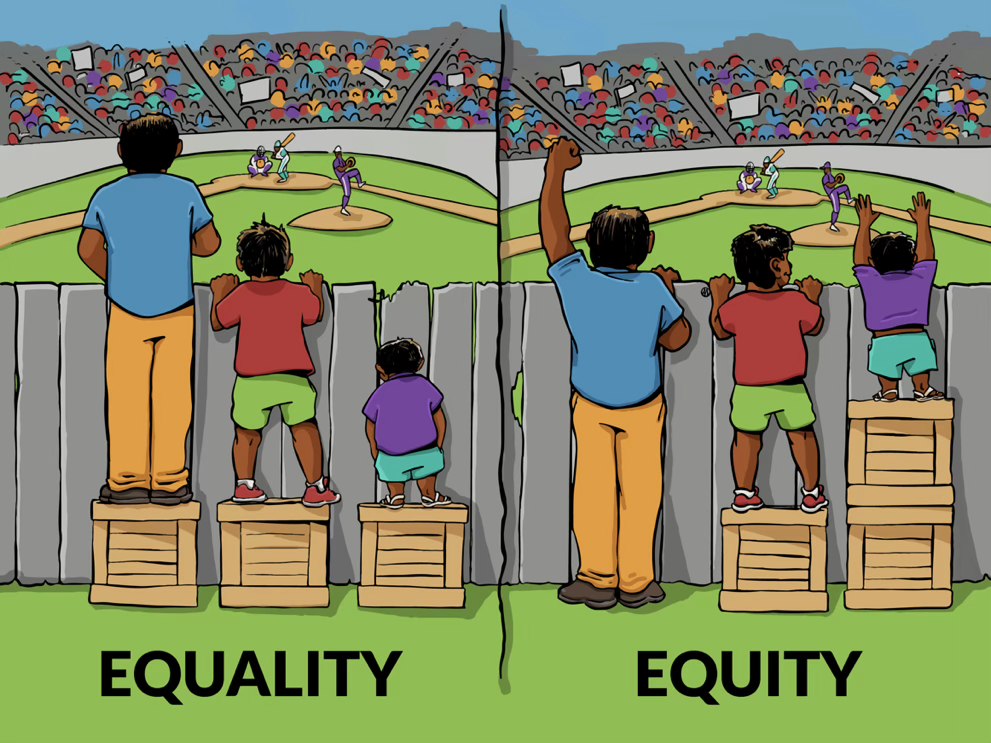
Scenario #1 (Equality)
A student in your class has a learning disability and asks the teacher for extra time on the upcoming test. The teacher replies, saying, “No, everyone gets the same amount of time to complete the test so that it is fair.” As a result, the student with the learning disability is unable to complete the test in time that they are given. Since they were unable to finish the test, their mark is poor, and the teacher does not let them complete it later.
Scenario #2 (Equity)
Using the same situation, a student with a learning disability asks the teacher for extra time on the upcoming test. The teacher says, “Sure, You can get an extra hour to complete the test, so you’ll have more time to read over the questions.” The student takes the test, and the extra hour enables them to complete the test and pass with a high mark.
Reflection
In what ways are these two scenarios different? In what ways are they the same? In what ways is equity better than equality? When/in what situation(s) do you think equality would work?
Overt vs. Covert Racism
Definitions
Let’s break it down. The word “covert” means something that is clear to view (something that is openly shown). The phrase “covert racism” refers to “racial discrimination that is concealed [hidden] or subtle rather than obvious or public” (Fitchburg State University). One thing to note about covert racism is that “its disguised nature allows” those performing covert racist acts to deny that they were doing so as the situation makes their actions seem passably acceptable. (Fitchburg State University).
The opposite of “covert” is “overt” which means something that is clear to view. “Overt racism” “is the intentional and/or obvious harmful…behaviours towards” a person or group because of their race (Fitchburg State University).
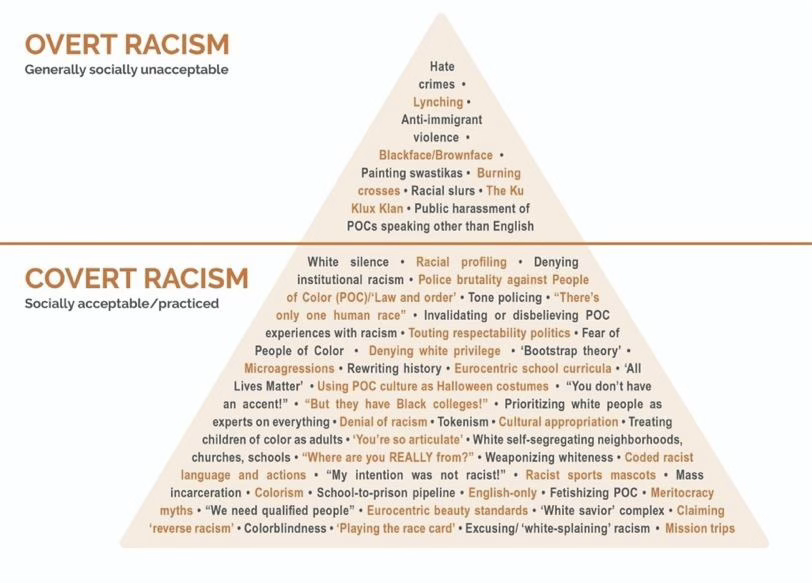
Scenario #1 (Covert Racism)
A new Black student, Luke, enters their first-period English class. Their teacher asks them to introduce themselves and they say that they immigrated from Scotland. When Luke sits at their seat, their peer beside them, Laura, asks, “Where were you born?” Luke, confused as they already answered this question a few seconds ago, responds, “I was born in Scotland.” Laura chuckles and rephrases her question, “Seriously? Okay. But like where are you really from?” Luke repeats their previous answer, “From Scotland.” Laura then asks, “Where are your parents from?” Luke says, “Scotland.” Laura keeps prodding, and asks, “And their parents?” Luke answers, “Jamacia.” And Laura asks, with a smirk on her face, “And their parents were from Africa, right?”
Reflection
Why didn’t Laura accept Luke’s first answer? Why did Laura keep asking Luke to go down his family’s immigration history? What answer was she really looking for? How do you think Luke felt at the end of their conversation? How do you think her response to their answers affected their sense of identity? How would you have responded?
Scenario #2 (Overt Racism)
A girl of Chinese descent gets on a public transit bus and is on her way to school. She is wearing her mask as it is pandemic times. As she sits down, a woman across from takes of their mask, spits on her, and says, “It was your people who caused this ‘Chinese Virus’. Go back to your own country an keep your diseases with you!” The bus driver immediately stops the bus and asks the woman to get off the bus, but she refuses. Other passengers who saw the incident call her how for being racist and also attempt to get her off the bus. The woman shouts, “I am not racist! It is a fact that her people caused this pandemic!” as police officers escort her off the bus.
Reflection
How is this scenario different to the other one (think about how the racist acts present themselves)? Why did the woman believe that people of Chinese descent were responsible for the pandemic? How are her beliefs dangerous (to herself and others)?
Privilege & White Privilege
Definition
Privilege is “a right or benefit that is given to some people and not others” (Merriam-Webster Dictionary). A great definition of “white privilege” comes from Francis E. Kendall: white privilege is when white people “[have] greater access to power and resources than people of colour [in the same situation] do” (Collins). White privilege stems from systemic racism. Systems that were put in place in the past (like Canada’s harsh immigration laws that you’ll learn about later) have allowed for white people to attain wealth and success earlier than those who are not white. Later on in this curriculum you will learn more about the different aspects of white privilege, but for now, this is just the basics.
Example
Two friends—Michael who is white, and Yusuf who is of Arab descent—are applying for an internship at a law firm. Yusuf has more qualifications than Michael, though Michael ends up getting the job. There was no face to face interview, though they did have to submit their resumes and conduct a phone interview.
Reflection
Why do you think that Yusuf did not get the job even though he had more qualifications?
While at first glance, one might just say that Michael was “lucky,” though analysing the data of how companies choose their employees, it is very likely that the company saw Yusuf’s name and associated him with the negative stereotypes attached to people of Arab descent.
Xenophobia
Definition
Xenophobia is “a deep-rooted, irrational (illogical or senseless) hatred towards or fear of foreigners (people who are not from that area), or of ideas or beliefs that are perceived as…strange or outside the norm” (White). In very simplistic terms, Xenophobia is a fear of people or ideas that are foreign or different from those in a particular society.
Example
World War II is a devastating example of xenophobia where the National Socialist German Worker’s Party (Nazi’s political party) attempted to irradicate Jewish people because of their religious beliefs.
Scenario Example
You are seated with your parents eating breakfast. Your dad is reading an article on his phone about the recent refugees Canada has been letting into the country. He scoffs and says, “This country is always letting those aliens (common insulting word for foreigners) waltz right through our doors. All they do is steal our jobs and bring their country’s problems with them. We need to keep an eye on them, you don’t know what they are capable of.”
Reflection
What is your dad angry about? Where do you think these beliefs originated from? Look at things from the refugee’s perspective for a moment; what do you think was on their mind when they immigrated?
Reverse Racism
Definition
Reverse racism is when people from minority groups are “given benefits at the expense of” white people “who, apart from race, would have had a superior claim to enjoy them” (Newkirk II).
Scenario Example
Two friends—Mustafa, who is of Arabic descent; and Samuel, who is white—are applying for scholarships for University. Mustafa comes across a scholarship that is specifically for people of colour. Samuel sees the scholarship and says, “That’s so unfair. They should hand out scholarships to people based on their academics not their skin tone. Honestly, it’s just racist.”
Reflection
Do you think that Samuel is right? How do you feel about the school’s decision to specifically give the scholarship to people of colour?
Colonization vs. Decolonization
Definition
Colonization is the process of taking power over the indigenous people of a certain area (SIFA). Decolonization is the process of setting free people from a colony meaning leaving it independent.
Example of colonization
People from Belgium settle in another country for the purpose of utilizing or using it’s people and natural resources while forcing their language and culture onto the indigenous people of the country they colonize.
Example of decolonization
The British people going back to Europe from the country they colonized so the indigenous people can go back to practicing their languages and cultures freely.
Marginalization
Definition
Marginalization is the process of making a person or group of people feel less important or powerless within society.
Example: SIFA
For example, an individual being left out for meaningful participation in a group processes an activity even though she /he is a formal member of the group.
Oppression
Definition
Oppression is the exercise of authority or power in a cruel or unjust manner. “Oppression” does not just relate to racial discrimination, but many other forms of discrimination like sexism, ableism, classism, etc.
Scenario Example
A group of friends goes to McDonald’s for lunch and are standing in line. A woman behind them pushes in front of the group, budding the line. One of the members of the group—a Black girl—says to the woman who skipped in front of them, “Excuse me, we were in line. You can’t just bud in front like that.” Another one of the group members—a white boy—says to the Black girl, “It’s fine! Gosh, you always gotta be the Black angry woman in every situation.”
Reflection
How did the girl’s friend assign a racial character to her? Why do we use the word “character” and not trait? How is what he said offensive?
White Supremacy
Definition
White supremacy is the belief that the white race is superior to any other race, and they should have control over people (SIFA). It also is the reasoning for why white people should live by themselves in a whites-only society (SIFA).
Example
An example of white Supremacy that you might be familiar with is the phrase, “Make America Great Again,” a.k.a. “MAGA.” It is the “again” that makes this statement problematic. America, and Canada alike, has had a rough history, especially when it came to racial issues. Seeing as how that is true, this phrase insinuates that America was a “great” place to live in the past, when it wasn’t, and still isn’t (racially speaking). And while this is an American-based example, it still relates to Canada in the sense that Canada, like America, blatantly ignores the large-scale racial issues that affect millions of people every day.
Reflection
What comes to your mind when you think of MAGA? How do you feel about the phrase?
Systemic & Institutional Racism
Definition
Let’s start with the definition of “systemic.” Systemic means throughout the whole system. Systemic racism is a racism that exists across a society. Institutional means a large organization. Institutional racism is racial discrimination that has become established as normal behaviour within a society or organization. So, institutional racism is part of systemic racism (SIFA).
Though what is important to note about racism in general is that racism is all of these things, systemic, institutional, personal and interpersonal. We just use these terms to specifically identify the forms that racism presents itself as. Though generally speaking, all racism is systemic as it is learned and passed down the generations.
Cultural Racism
Definition
“Cultural racism refers to the representations, messages and stories conveying the idea that behaviours and values associated with white people or ‘whiteness’ are automatically ‘better’ or more ‘normal’ than those associated with other racially defined groups” (Racial Equity Tools).
Examples
- “Nude” as a colour usually refers to lighter colours
- Certain facial features, that are usually attributed to people of European descent, are considered to be beautiful; while facial features attributed to Black people are considered ugly.
Leave a Reply